All too often, stories of the future erase disability through cure, eugenics, or a simple lack of imagination. If disability does show up in science fiction, it is usually a signal of dystopia; the reader knows something has gone wrong when the fish arrives with three eyes.
In 2023-2024, HIVES workshop and speaker series on disability in relation wanted to transform our relationship to the future, telling stories with bodymind variation at the center. For our events, we insisted upon the centrality of imagining disability and more-than-human relations in our acts of speculation.
How will the stories we tell about disability change in the future? This question led us to prompt generative AI with the task of depicting disability futurity. The images we received had wheelchairs in the middle of staircases and a lot of remixes of the accessible parking logo. Letting a large language model average present understandings of future possibilities for disability didn’t lead us to many hopeful images. Unless, we hoped to fall down some stairs.
This isn’t to say that potent stories of disability futures don’t already exist. In N.K. Jemisin’s speculative postcolonial utopia “The Ones Who Stay and Fight,” the presence of accessible rail and people who self-describe as deaf are each counted among the signs utopia has arrived. Sami Shalk’s Bodymind’s Reimagined analyzes black woman’s speculative fiction showing how it can transform understandings of the social construction of race, gender, and (dis)ability.
So this year our events centered on people (not LLMs) already doing the work to center disability in their storytelling.
We welcomed Dr. Soohyun Cho to present her talk titled “Art in Health: Building Social Connections Through Fandom and Artmaking.” During this event, Cho talked through the media phenomenon of autistic-coded, solo detectives and how fans remixed these stories in crafting online communities.
Then, HIVES was able to celebrate the release of Naomi Ortiz’s new book, Rituals for Climate Change: A Crip Struggle for Ecojustice with a reading and discussion with the author. We spoke about the role of imagining the future in this present moment of climate change. In Ortiz’s poem, “Future Orientation,” they wonder with their crip partner what they’ll do when the water runs out. There’s no good answer. The partner speculates “We may just need to leave and lose everything.” But they keep imagining how “to plot our way through/ what was once thought extraordinary/ turned real.” This offering for Ortiz feels like one of the most compelling roles for speculation in a rapidly shifting present.
Following Ortiz, we wanted to attend to the necessity of speculation in shaping our politics of the present. In Migrant Futures: Decolonizing Speculation in Financial Times, Aimee Bahng offers a means to speculate in ways that open futurity to a plurality of bodyminds and ways of being by proposing a “politics of mutation,” where “mutation finds its expression in changing the materiality of a thing, likely in ways that alter conceptualizations of bodies, differentiation, origins, and copies” (151). HIVES mobilized this politics of mutation to shape our spring events to, as Bahng puts it, “persist speculatively, against all odds… to hold open the aperture to the beyond, where the systems that seemingly dominate cease to overwhelm” (170).
For us, this meant taking on the work of mutation in the classroom and beyond it. We opened the year of 2024 with an act of speculation with Assistant Professor in the Center for Integrative Studies in the Arts and Humanities at Michigan State University Garth Sabo and Assistant Director of Assistive Technology Innovation for MSU’s Resource Center for People with Disabilities Tyler Smeltekop. In a three-way discussion, we considered the tools we have now for shaping more accessible classrooms and speculated on what more radical approaches to access we’d need to address our future concerns.
At Eastern Tennessee State University, HIVES co-coordinator Jessica Stokes led the generative workshop “Speculative Sutured Selves” invited by Basler Chair of Excellence Caro Novella to the Rehearsing Care Lab. In this workshop, Stokes encouraged participants to reimagine the future through the limitations of the present. Participants created speculative cut-up poetry from medical journals, personal medical paperwork, and diagnostic handbooks. Using the limited terms of doctor’s handbooks and personal medical records to envision a future that embraced, rather than stigmatized, these terms, participants were introduced to disability studies perspectives on valuing bodymind variation and intervening in the often stigmatizing language of diagnosis. Stokes worked with participants from around the university, including a group of clinical psychologists who were particularly interested in transforming the (DSM-5-TR)–the Diagnostic and Statistical Manual of Mental Disorders. Some of the poetry and collage from this event is featured in the zine.
We ended this year’s programming with a visit from transqueer puppeteer, clown, cardboard constructionist, and maker of plays, parades, pageants, suitcase theaters, and low-tech public spectaculah, Eli Nixon. Nixon led HIVES participants from MSU and the broader community in a day-long workshop of cardboard transformation and play. Together, we speculated on what we could make using cardboard, fabric, tape, and paper donated by the MSU Recycling Center and how our creations might interact with one another in a speculative future. This time for creation in relation gave us room to speculate on Stacey Alaimo’s work with transcorporeality, “in which the human is always intermeshed with the more-than-human world, [and] underlines the extent to which the substance of the human is ultimately inseparable from ‘the environment’… [while opening] a mobile space that acknowledges the often unpredictable and unwanted actions of human bodies, nonhuman creatures, ecological systems, chemical agents, and other actors” (2). In this enmeshed network of speculation, HIVES attended to ways present injustice limits our imaginaries of tomorrow as we expand our constellations of the possible.
This zine is the aftermath of our year of imagining. As Scott Norman Rosenthal writes in the poem “Electroshock, Sovereignty” “We are more than the ledgers/ of our naming./ Louder than the silence of our living.” We welcome you, dear reader, into a series of images, collages, and poems that open up space and time for bodymind variance. We invite you to make more, to make noise, to transform, and to engage in your own politics of mutation after you read. How will you keep the aperture to the beyond open a little longer?
This zine was made possible through an interdependent network of support, including but certainly not limited to friends, animal companions, hermit crabs, Michigan State University’s English Department, a Michigan State University Creating Inclusive Excellence Grant, and support from the Creativity in the Time of Covid 19 Grant. If you are curious about what HIVES is, does, and will do: visit behives.org.
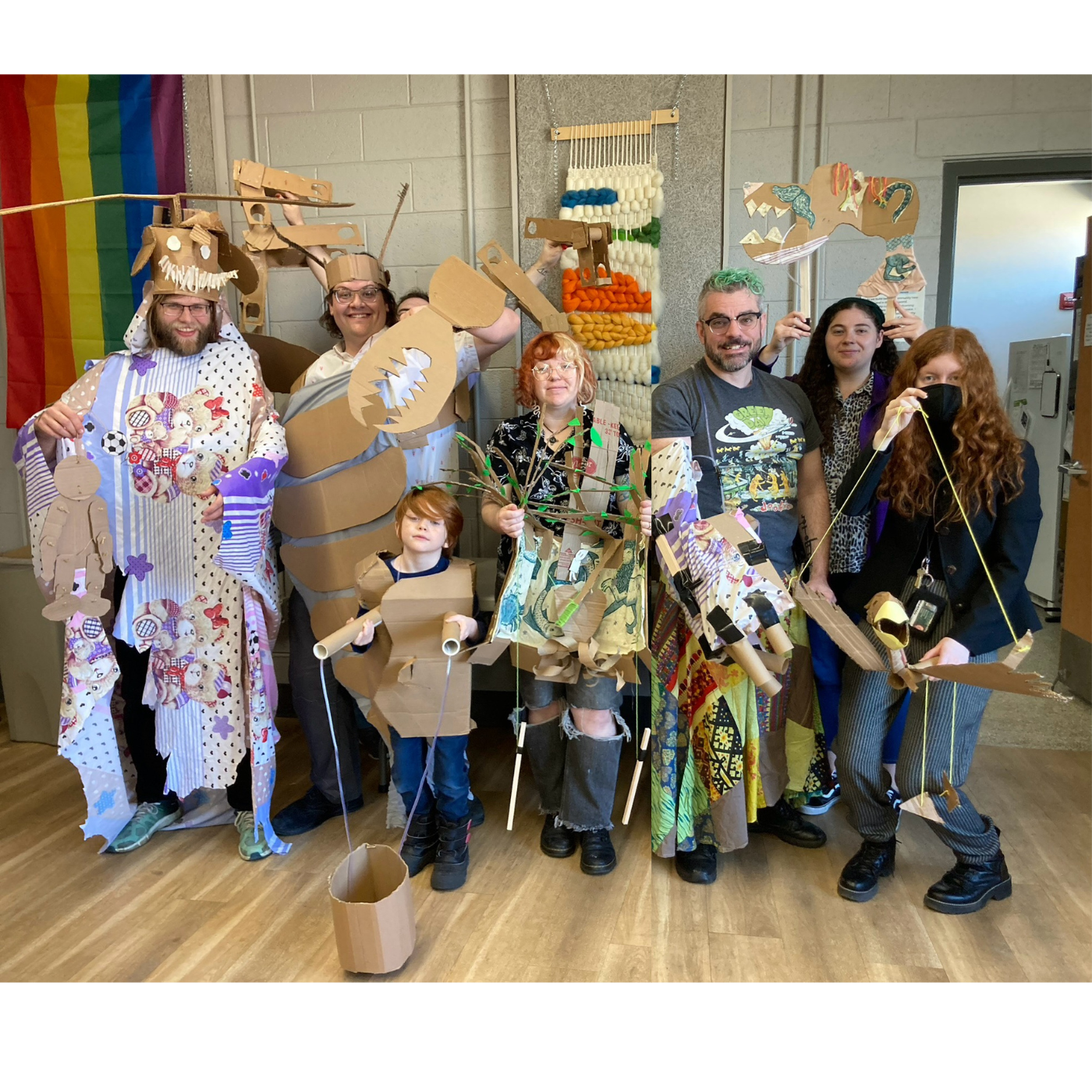
Image Description:
A multi-aged group of workshop participants line up in front of a rainbow flag to show off cardboard creations, including stage-inspired costumes, occupational therapy devices, crayfish, forests, and vultures. Check out Eli Nixon’s Blood Tide to learn how to make your own cardboard creations.
 HIVES
HIVES 