HIVES combines research and play to make art and scholarship accessible.
Past themes:
(2024-2025)
The presence of disability in futures, fictional and otherwise, has been a driving force for the coordinators of HIVES. In her work Bodyminds Reimagined, Sami Schalk discusses the importance of storytelling and speculation in cultural conversations, emphasizing how “these discourses, systems, and identities impact our experiences of reality and how a lack of recognition for differing realities has punitive and dangerous results for some populations than others” (62). Last year, HIVES welcomed Ames Loji as co-coordinator for a series of events anchored in water justice and disability. We welcomed disabled Indigenous artist and activist moira williams to MSU to lead a workshop invoking aqueous eco-monster ancestors and to elaborate on their pleasure activism that brought an accessible bathroom to New York City’s waterfront. We connected MSU faculty, graduate students and undergrads with former New-Zealand poet laureate and Pacific literature scholar Selina Tusitala Marsh as she attended to disability as difference that makes difference. The year culminated in a hybrid keynote talk by Chanika Svetvilas on her work “Anonymous Was The Data” a collaborative art project that focuses on the lived experience of mental health difference and the impact of the stigma and inequity of access to care on Asian American and Pacific Islanders (AAPI). As we look forward to another year of programming, HIVES is focusing on the practices that we use to imagine disabled bodyminds into an ever more precarious future.
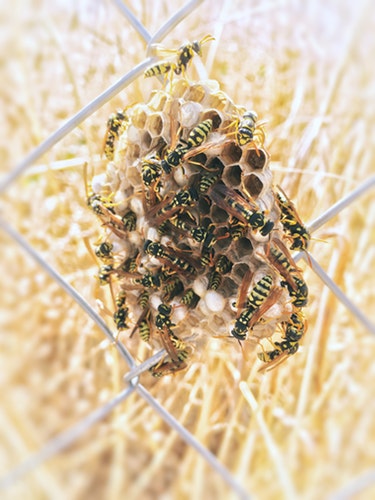
Do you have HIVES yet? From buzzing into a sci-fi future that’s not attuned to human biological needs? Because you’ve been touched by a well-meaning but misunderstood sewer mutant? Because you get goosebumps when you witness vibrant queer-crip communities? HIVES is capitalized not because it’s an acronym, but rather as a gesture toward the material reaction of bumps on skin and the physical space of a beehive. This research workshop reimagines the communities of the future, stretching towards a plurality of possible tomorrows that refuse the homogenous, all-chrome, all-superhuman narratives that occupy the temporal space beyond the now. In Migrant Futures: Decolonizing Speculation in Financial Times, Aimee Bahng offers a means to speculate in ways that open futurity to a plurality of bodyminds and ways of being, she notes that “to think of migrant futures is to posit that which may never come to pass but must nevertheless persist speculatively, against all odds. Perhaps the primary function of their existence is to hold open the aperture to the beyond, where the systems that seemingly dominate cease to overwhelm” (170). HIVES programming for the 2023-4 year will stretch our limbs and mobility devices toward possibly unreachable beyonds. Working across a broad history of media, HIVES will open dreaming space for accessible and vibrant tomorrows and tomorrows and tomorrows.
Thinking about the movement of the human between the present moment into a multiplicity of futures, HIVES will incorporate a network of connections, thinking alongside Stacy Alaimo’s description of transcorporeality, “in which the human is always intermeshed with the more-than-human world, underlines the extent to which the substance of the human is ultimately inseparable from ‘the environment’… [while opening] a mobile space that acknowledges the often unpredictable and unwanted actions of human bodies, nonhuman creatures, ecological systems, chemical agents, and other actors” (2). In this enmeshed network of speculation, HIVES will attend to ways present injustice limits our imaginaries of tomorrow as we expand our constellations of the possible. This year, HIVES will work with participants to consider how we’ve collectively imagined what tomorrow brings and then to recognize how we might expect more from the future. In this way, HIVES will embrace the possibilities of a “politics of mutation,” which Aimee Bahng puts in comparison with regeneration to note that “whereas regeneration’s aim is to restore a body to an original or normative state, mutation finds its expression in changing the materiality of a thing, likely in ways that alter conceptualizations of bodies, differentiation, origins, and copies” (151). HIVES will mutate material existence and speculative futures as we embrace practices of transformation.
(2022-2023)
The HIVES community continues to converge, diverge, and pour into basins and estuaries. Last year, HIVES welcomed Naajidah Correll as a guest co-coordinator of events at the intersection of disability, race, and performance. We held writing and pedagogy workshops, film screenings, and evenings of performance, poetry, and essays. As we wound between these banks, currents led us to questions about environmental racism, disability, and the waters, from dirty rivers to polluted aquifers to irradiated oceans, which produce disability in humans and animals and are themselves disabled by humans. This year, HIVES welcomes Ames Loji as guest co-coordinator as we wade into the flows in and between neurodivergence, madness, and disability.
Do you have HIVES yet? From swimmer’s itch? From being stung by a bee while wading into the buzzing conversations happening on the shores of the Red Cedar River? HIVES is capitalized not because it’s an acronym, but rather as a gesture toward the material reaction of bumps on skin and the physical space of a beehive. This research workshop reimagines the communities flowing through estuaries of disability, madness, and neurodivergence. This year, HIVES leans and limps into these ebbs and flows to contemplate the oceanic scale of disability through a tidalectic framework. In Tidalectics, Stephanie Hessler posits that this approach “allows us to think of hybridity, cross-cultural syncretism, incompleteness, and fragmentation. It holds a flexible approach to geography that accounts for land forming in volcanic eruptions and islands disappearing over time due to climate change and other processes that remain forever unresolved” (Hessler 34). Thinking across these scales in oh-so-partial ways, HIVES attends to our interdependent relationships with bodies of water that lap into disability, madness, and neurodiversity.
In her work on “Disabled Ecologies,” Sunaura Taylor, who herself was disabled by an aquifer polluted by the US military, creates space to hold her disability alongside disabled ecosystems. She “imagine[s] the geological formation, sediments, and ancient water that make up the aquifer as a sort of 19th century invalid, sensitive to its environment, to external influences” as she learns to “hate the military but love [her] body” and love the water that changed her (Taylor). HIVES lingers with this example as we bring together material conversations across disability communities, human and nonhuman alike. In doing so, we think through the fragmented and fragmenting relationships between waterways and people. In Animacies, Mel Y. Chen writes of attending to the affinities that emerge when people who are pejoratively compared to non-living things attend to the kinships made possible by the comparison. They write “taking in animacy in this way [in which communing and transmogrification among unlikely kinds is not exceptional, but normal and unsurprising] also suggests an alternative means, outside of the strictly political or strictly emotional, to identify cross-affiliations –affinities–among groups as diverse as environmentalists, people with autism, social justice activists, feminists, religious believers in nature’s stewardship, and antiracists” (236). This year, we seek such sprawling, incomplete, fragmentary, yet growing conversations.
(2021-2022)
At HIVES’ emergence, we never intended to linger in a singular set of themes or conversations. We meant for HIVES to spread out and form sprawling interdependencies: vibrant combs and entangled communities. Due to the constrictions of grant funding and the disruptions of COVID-19, HIVES lingered in the space of disability studies, animal studies, and popular culture for two years. This year, however, we are expanding the “we” of HIVES and welcoming co-coordinator and collaborator Naajidah Correll. Together, we are glad to be embarking on the first of HIVES’ many mutations as we turn to conversations on disability, race, and performance.
Do you have HIVES yet? As the result of a compelling performance? Due to an allergic reaction? Or after joining the buzzing communal space of the hive? HIVES is capitalized not because it’s an acronym, but rather to gesture toward the material reaction of bumps on skin and the physical space of a beehive. This research workshop seeks to reimagine a community space, a hive, for conversations on disability, race, and performance. In Bodyminds Reimagined, Black feminist disability studies scholar Sami Schalk exhorts “disability studies scholars to not merely include race, but to allow black feminist and critical race theory to transform the field.” In her piece, “Toward A Crip of Color Critique,” woman of color scholar Jina B Kim seeks to move away from a disability studies centered on a disabled subject and instead to consider disability as verb: “to take seriously disability as methodology is to take seriously this politics of refusal, to recognize disablement and racism as inextricably entangled, and to enact intellectual practices—like resistance to hyper-productivity—that honor disabled embodiment and history.” In seeking practices of resistance and disruption, we turn to the work of performers, writers, and artists drawing on disability and race, as well as their entanglements, to transform fields and imagine otherwise.
(2019-2021)
HIVES is an ongoing scholarly, artistic, and communal organization dedicated to developing an understanding of the ways in which matter and beings function in interdependent networks. This research workshop seeks to create a generative space for conversations at the intersections of disability studies and animal studies in popular culture. In his book Brilliant Imperfection, Eli Clare emphasizes how “White Western culture goes to extraordinary lengths to deny the vital relationships between water and stone, plant and animal, human and nonhuman, as well as the utter reliance of human upon human” (Clare 136). Clare offers the disability studies notion of interdependence as a way to undo fantastical narratives of independence and the individual. HIVES is an engagement with hiveminds, relationality, and interdependence across and within animal/human divides. This research workshop draws on popular culture in the form of novels, films, and video games and theory from disability studies to critical race theory to queer studies to animal studies in order to think through disrupting white western denials of interdependence. We are guided by the questions: what are the potentials and pitfalls of the overlap between disability and animal studies? what forms of inter-reliance arise from lived disabled existence and/or representations of disabled characters in popular culture? what does (and does not) separate animals and humans? what frictions exist in turning to animal studies to find alternate conceptions of relational being?
HIVES coordinators:
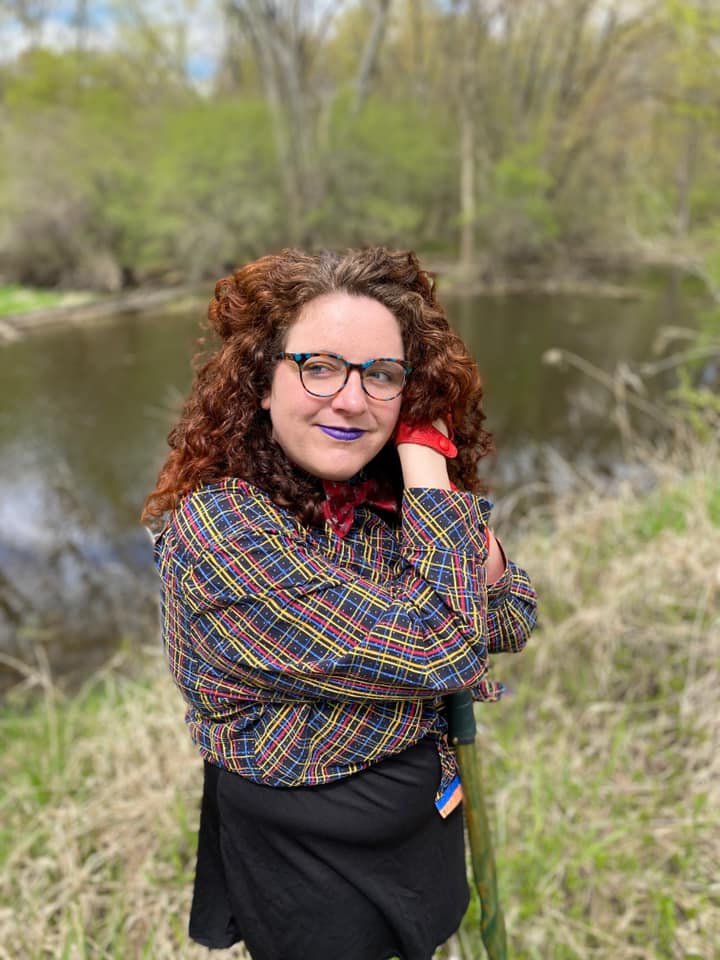
Jessica Stokes has a purple wheelchair and a lot of red hair.
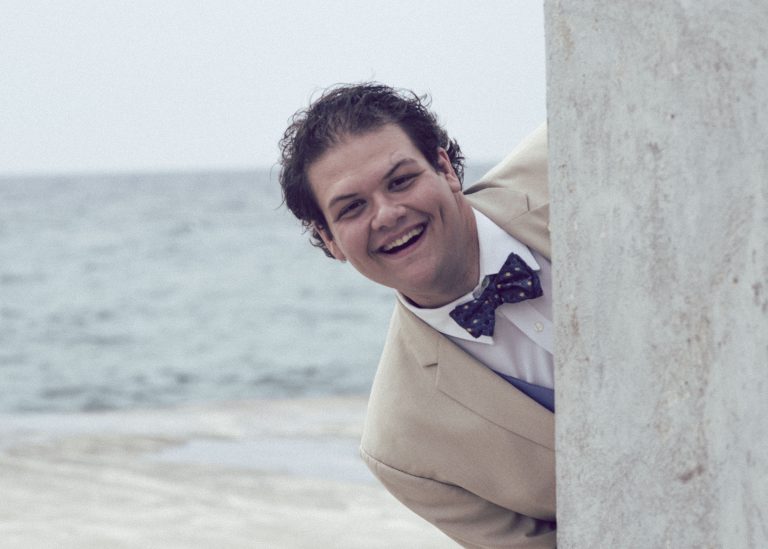
Michael Stokes is a sci fi buff who is not buff.
HIVES contributors (an obviously non-exhaustive list):
Ames Loji (co-coordinator 2022-2023; editor of Buzz-Zine Vol. II )
Naajidah Correll (co-coordinator 2021-2022; editor of Buzz-Zine Vol.II; ongoing collaborator)
JJJJJerome Ellis
Eli Clare
Petra Kuppers
MSU’s Council of Graduate Students
Dean Bill Hart-Davidson
Valerie O’Brien
Zarena Aslami
Scott Michaelsen
Trixie Smith
Jonny W. Thurston
Natalie Phillips
Cheryl L. Caesar
Kimberly Ann Priest
Anuj Vaidya
Maurice Moore
Cavar
Marisa Lucca
slp
Ann Millett-Gallant
Claire K. Robbins
Mike Gill
Daniel Christmann
Hilda Smith
seeley quest
Ashanti ‘Shanti’ Collins
Gaia Celeste
Molly Joyce
Lisa Alexander
kaje jasper wildz
Maria Oshodi
Martin Sweeney
Alana Gracey
Rajah Sandor
Naomi Ortiz
Chanika Svetvilas
Miguel Esteban
Naheen Ahmed
 HIVES
HIVES 